Key Highlights
- Modern Implementation: pyFrost-GM is an open-source Python 3 architecture of the LoKI-GM plasma chemistry suite.
- Rigorous Validation: Successfully benchmarked against canonical literature for complex oxygen discharges.
- High Accuracy: Precise self-consistent resolution of E/N, gas temperatures, plasma densities, and reaction pathways.
pyFrost-GM is designed for low-temperature plasma chemistry and kinetics simulations, featuring a modular physics engine coupled self-consistently with the LoKI-B-cpp Boltzmann electron energy distribution function (EEDF) solver. To ensure code correctness, the solver's outputs were validated against the benchmarks published by Dias et al. (2023) and Alves et al. (2026).
The O₂ Discharge Chemistry
The model tracks an oxygen DC discharge where electrons, driven by the applied electric field, dissociate and excite molecular oxygen through collisions. The resulting chemistry couples electron-impact dissociation (e + O₂ → e + 2O), vibrational energy transfer (VT and VV processes across 42 vibrational levels of O₂(X, v)), electronically excited states including singlet delta O₂(a¹Δg), wall recombination of atomic oxygen, and — at higher pressures — three-body ozone formation. All of these channels feed back into the electron energy distribution through the self-consistent EEDF coupling.
Note: While this page showcases oxygen discharges, additional chemistries such as N₂, CO₂, and more are available upon consulting request.
Need a cloud-ready, validated translation of your scientific code?
Whether it's investigating specific plasma chemistry questions or adopting these AI/V&V methodologies for your own tools, we can help build your auditable, highly deployable architecture.
Contact Us for a ConsultationValidation Results: Reduced Electric Field and Gas Temperature
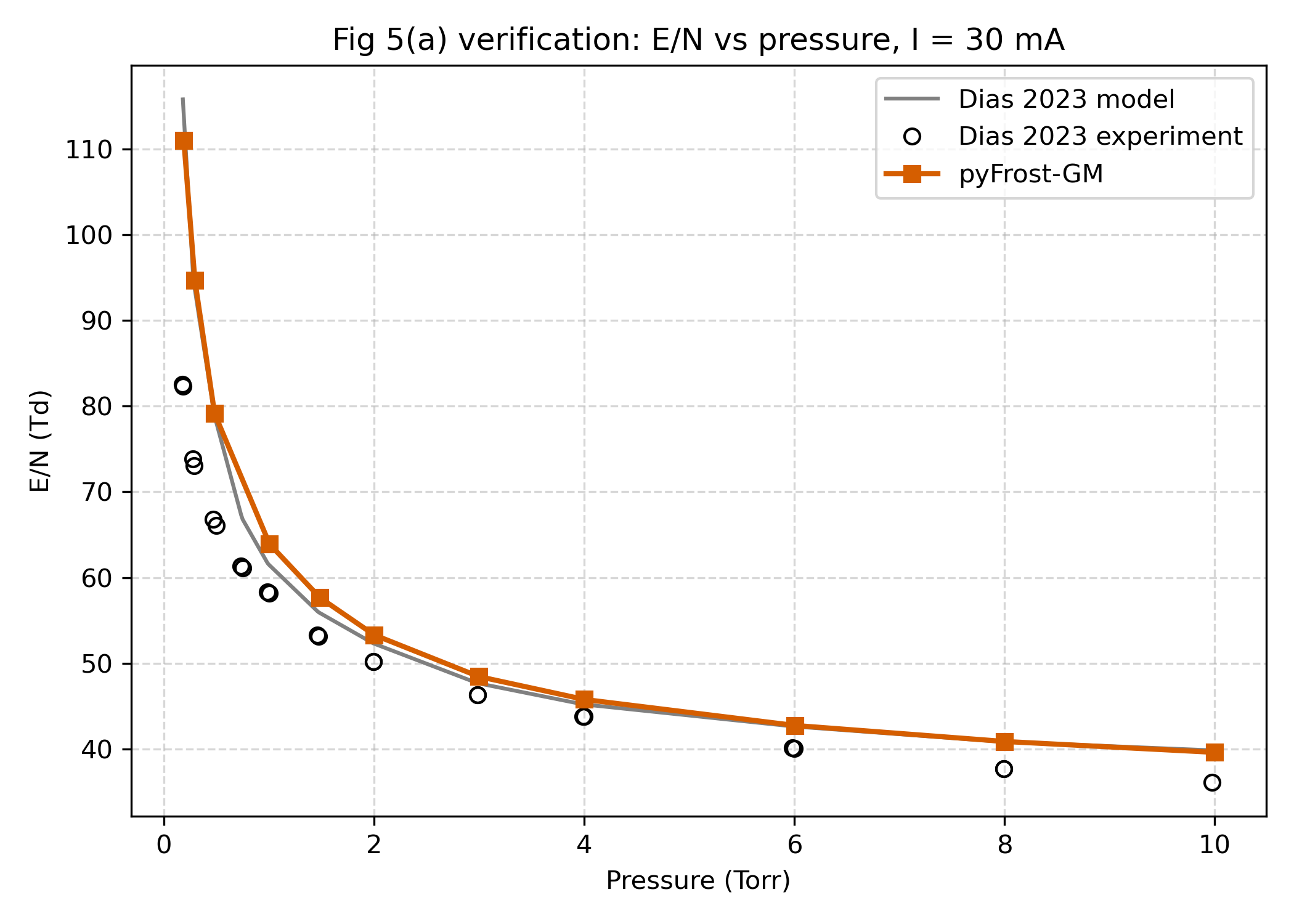
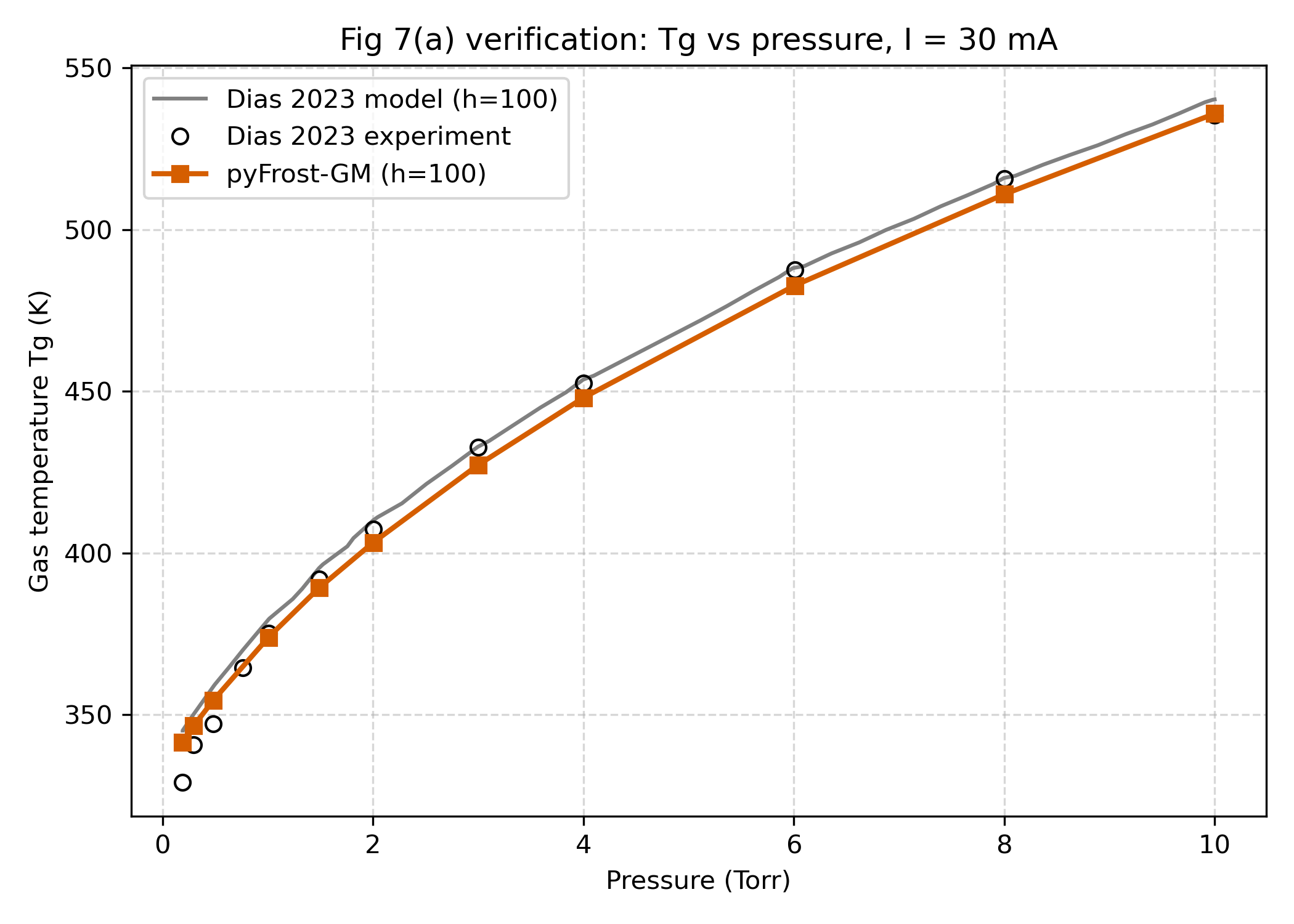
We validated the self-consistent convergence of the reduced electric field ($E/N$) and the average gas temperature ($T_g$) over a pressure sweep from $0.2$ to $10$ Torr in a DC cylindrical oxygen discharge (discharge current $I = 30$ mA, chamber radius $R = 1$ cm).
Plasma Densities and Active Species
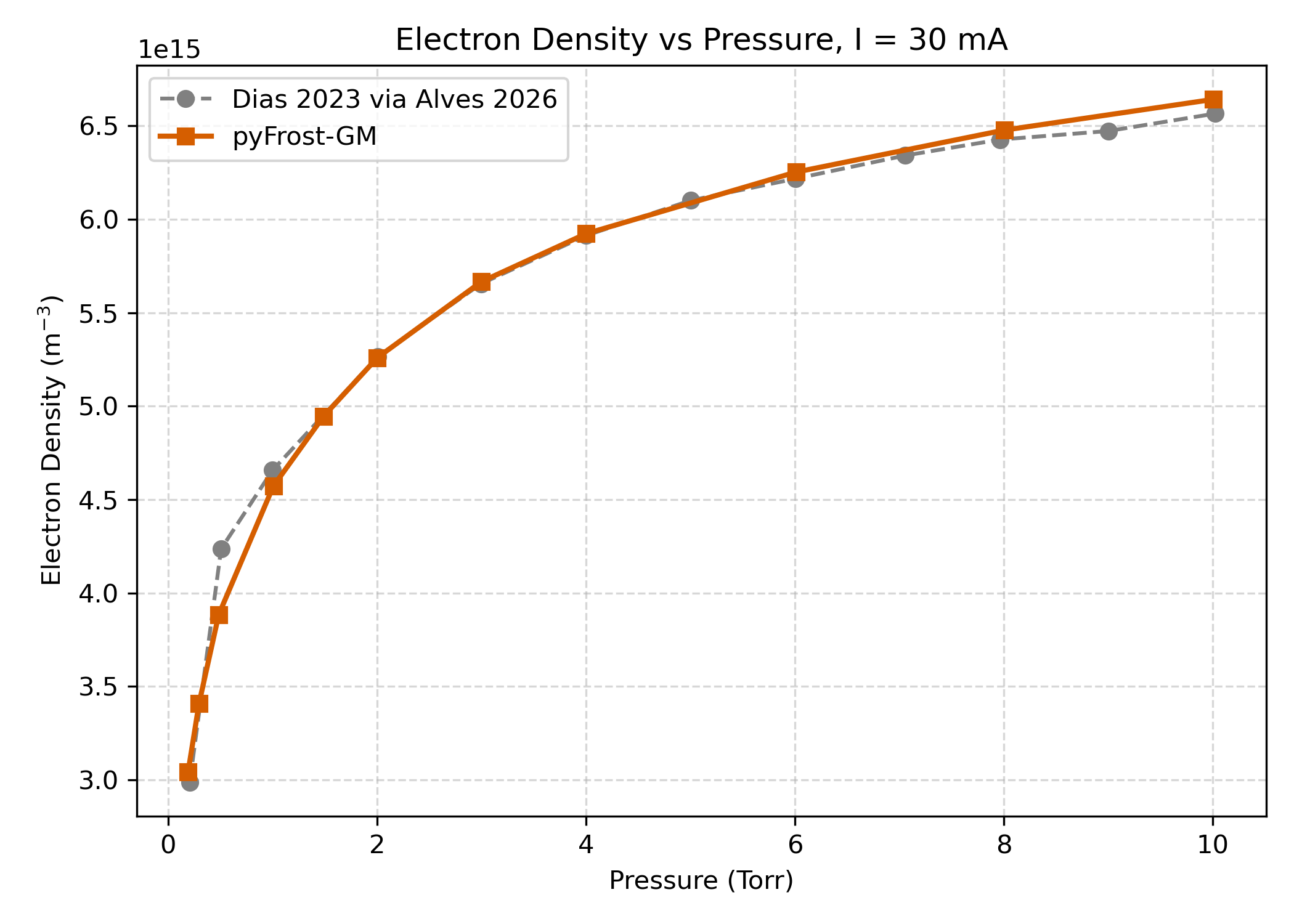
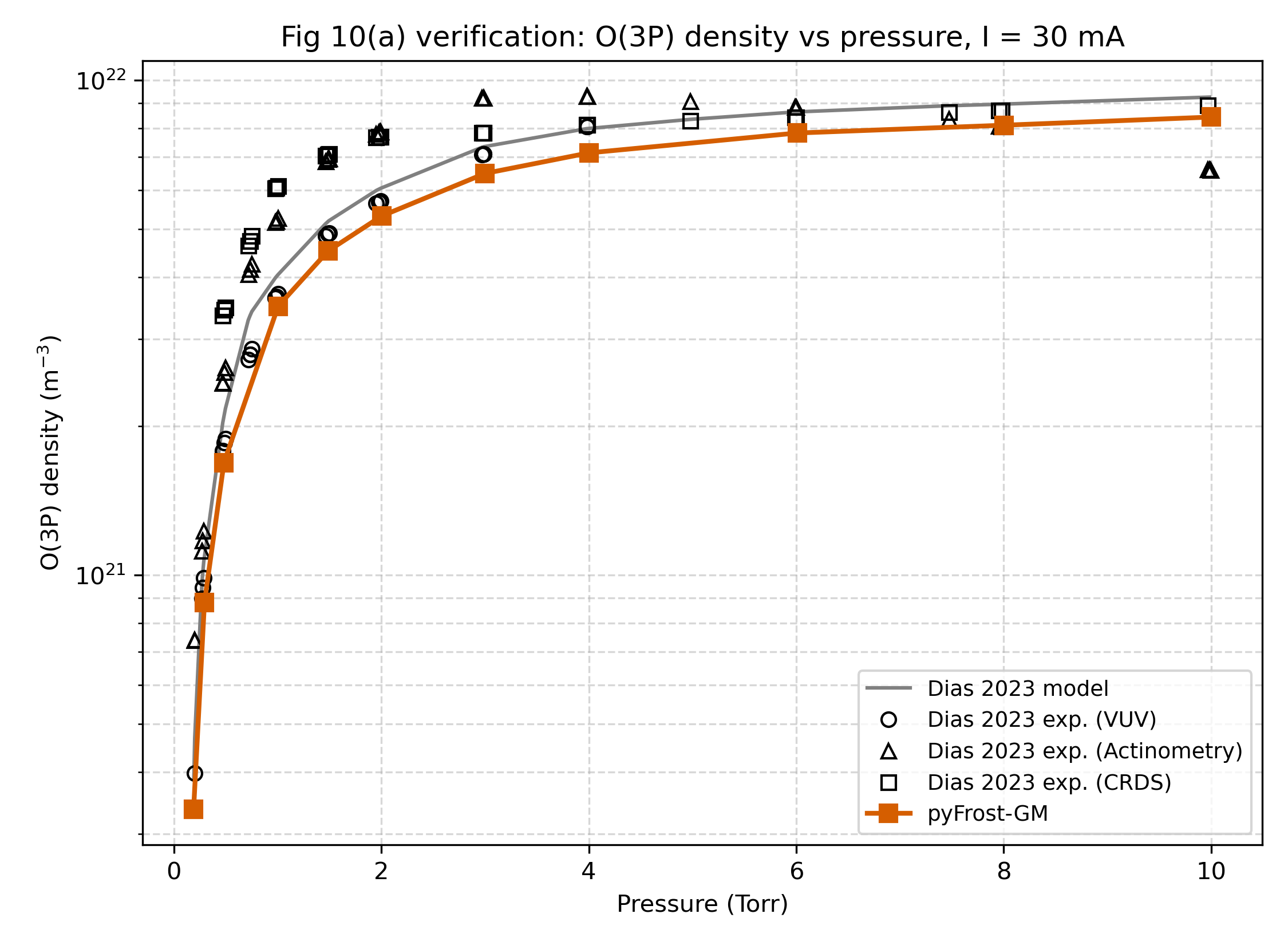
The electron density ($n_e$) and atomic oxygen ground state $O(^3P)$ density show excellent agreement with experimental data and reference model values.
Singlet Delta Oxygen and Vibrational Distribution
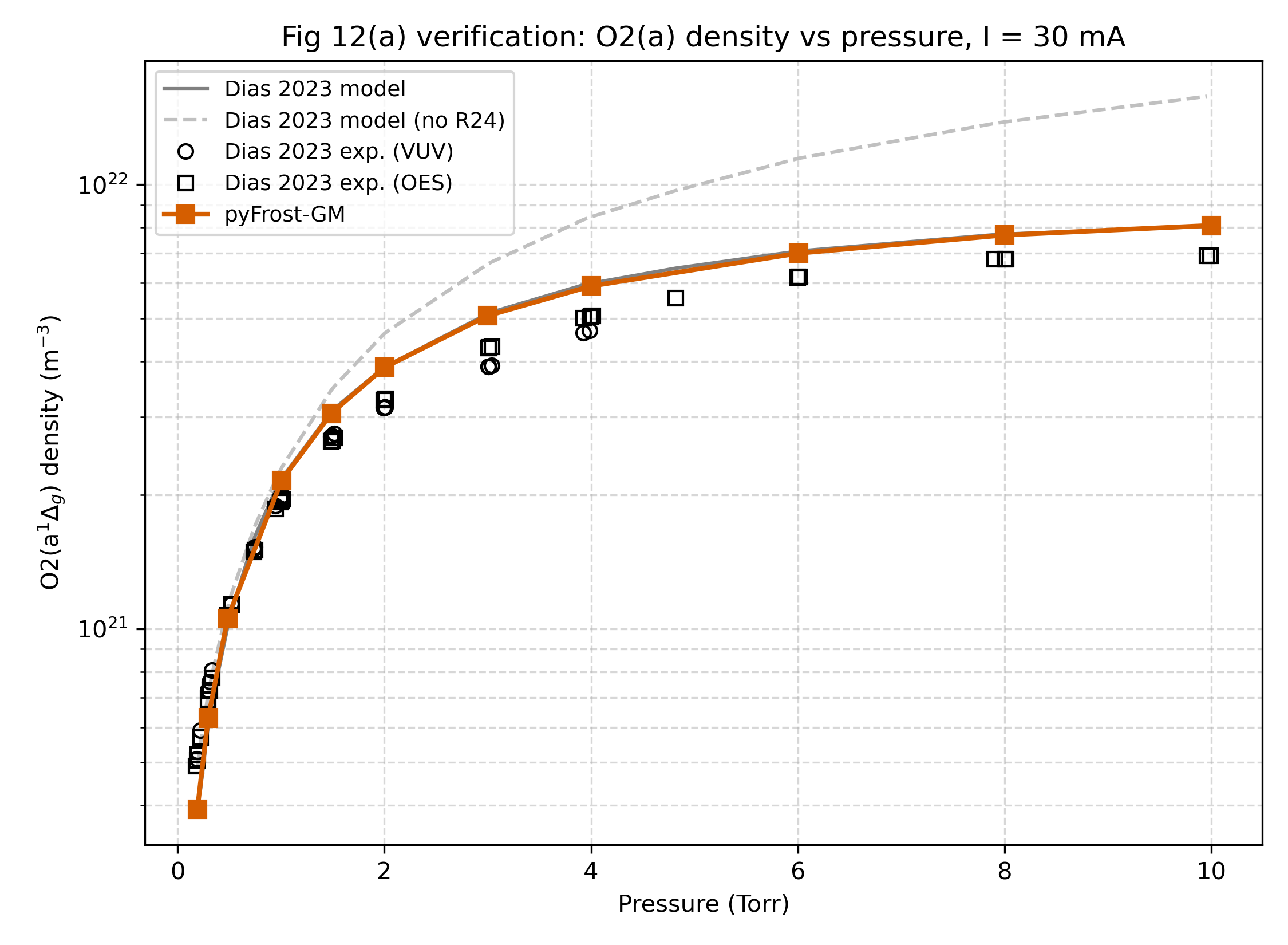
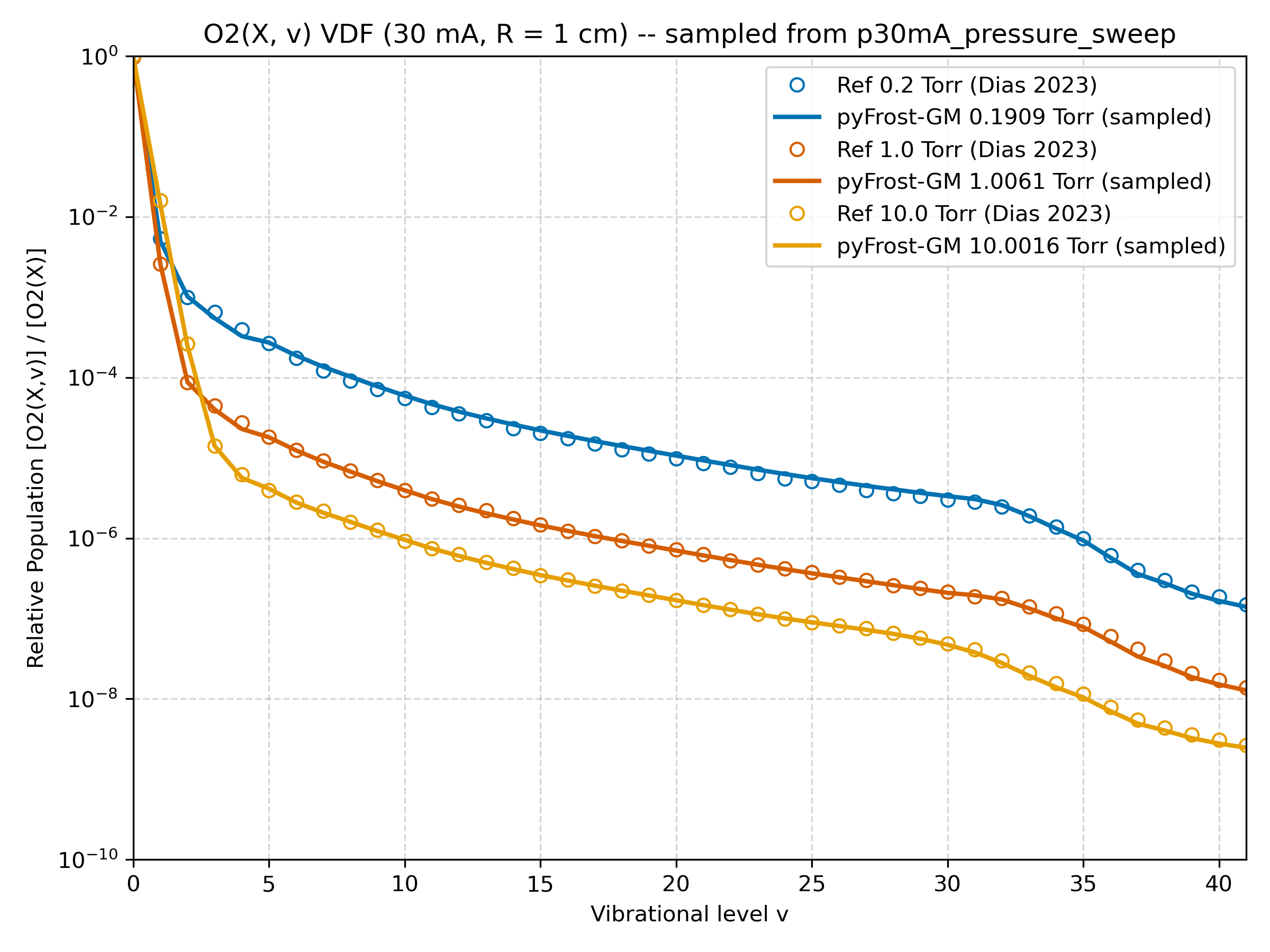
The singlet delta oxygen $O_2(a^1\Delta_g)$ density and the Vibrational Distribution Function (VDF) of the ground state $O_2(X, v)$ for $v=0$ to $41$ are captured with high precision.
Reaction Pathways Analysis
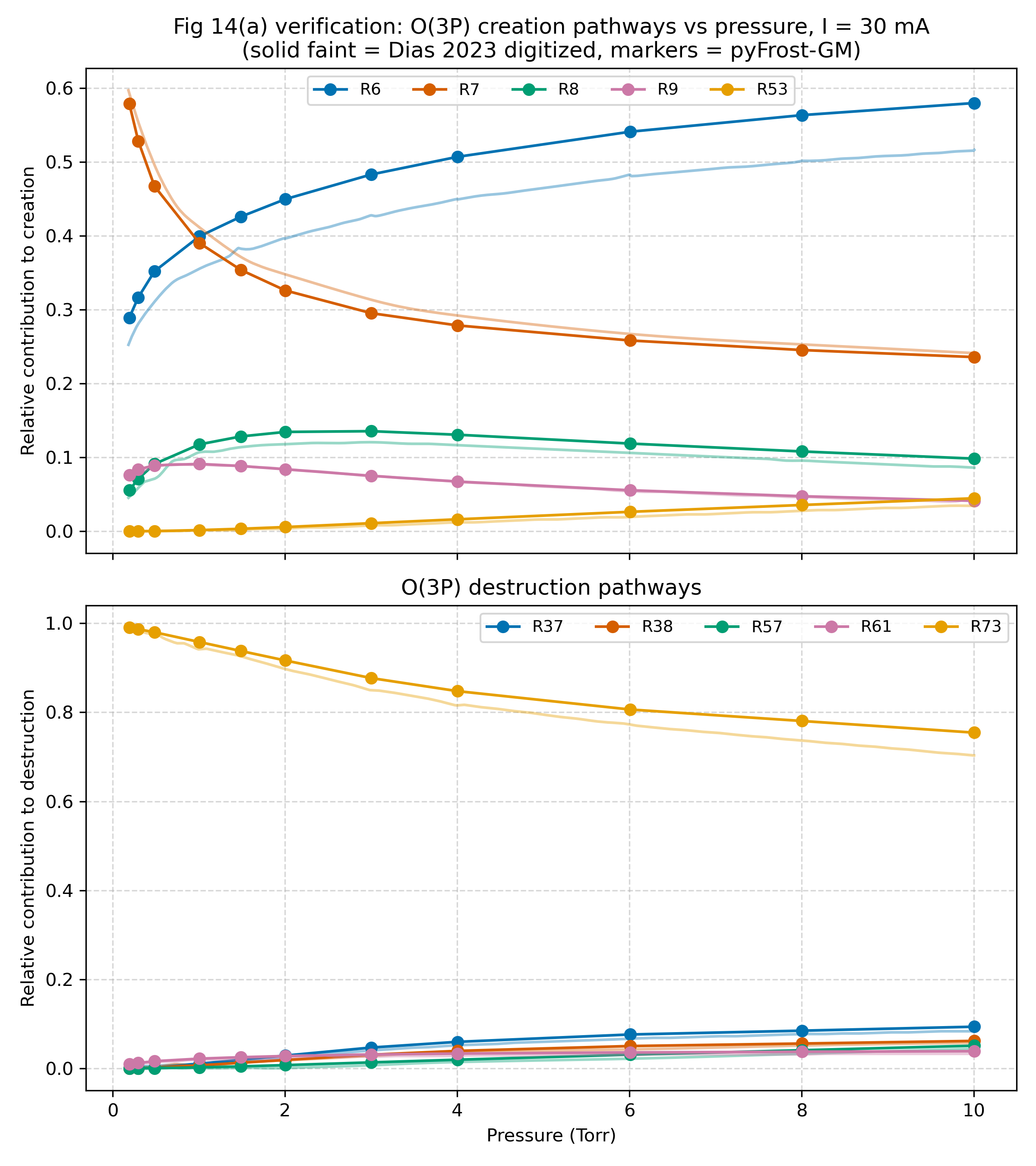
The relative contributions of individual reactions to the creation and destruction of atomic oxygen ($O(^3P)$) were tracked as a function of pressure. The simulation accurately reproduces the shift from low-pressure wall recombination and electron impact dissociation to high-pressure ozone-mediated three-body processes. Some differences remain: the electron-impact dissociation channel R6 (e + O₂(X,0) → e + 2O(³P)) contributes more to $O(^3P)$ creation than in the reference, which points to the loss terms running somewhat high or a pathway still missing from the reimplementation. Residuals like this are what successive V&V campaigns target, guiding the code checks and further implementation that progressively bring pyFrost-GM in line with the baseline.
Bibliography
- [1] Tejero A et al, "The LisbOn KInetics Boltzmann solver" 2019 Plasma Sources Sci. Technol. 28 043001. DOI: 10.1088/1361-6595/ab0537 (Open Access)
- [2] Tejero A et al, "On the quasi-stationary approach to solve the electron Boltzmann equation in pulsed plasmas" 2021 Plasma Sources Sci. Technol. 30 065008. DOI: 10.1088/1361-6595/abf858 (Open Access)
- [3] Alves L L et al, "LoKI-GM: a global model tool for plasma chemistry studies" 2026 Plasma Sources Sci. Technol. (in preparation). DOI: 10.48550/arXiv.2607.27234
- [4] LoKI-GM (Official GitHub Repository)